• Hello and welcome


    Welcome to Procedural - Making Chemistry Easy's online education offering!  We hope that you use this resource to the maximum ability.

    Some step-by-step advice for maximum impact of this resource:

    1. Start by watching the main video(s) in a sub-section of a category. 
    2. Then work through the example alongside the teacher in the example videos.  We strongly suggest you have your resources handy - calculator, periodic table etc... so you can do the logic, counting, math at the same time as the video (pausing as required) to achieve the same answer.
    3. Hopefully with confidence lifted, you can have a go at the worksheets and check them again the answers in the same sub-section.
    4. Now that you have some understanding, try the multiple-choice quiz to see if  you have mastered it.

    Chemistry is not a difficult subject, it is a large one.  There are lots of points of fundamental understanding that lead to complex and beautifully logical outcomes if they are learned, understood and then logic is applied.  This resource is your chance to prove that.

    The very best of luck in your learning, do a little every day - you can't cram a logical science, it needs to build on itself.  Save the cramming time for the rote-learnable (cough biology cough) sciences riseta

    The team at Procedural - Making chemistry easy.
Cursos disponibles

Topic based learning systems of:

Chemical bonding
Chemical calculations
Equilibrium (including acid/base and solubility)
Redox and metal-ligand interactions
Chemical energetics
Chemical kinetics
Organic chemistry and reaction mechanism
Relating these things to the chemistry of biological systems

And all of the above topics in the context of biological chemistry

Chemistry fundamentals
Learning objectives, tick them off as you are able to:

  1. Identify the charge and location of protons, neutrons and electrons
  2. Count the number of protons, neutrons and electrons
  3. Know what changes when the number of protons, neutrons and electrons changes
  4. Appreciate the periodic table is laid out by reactivity
  5. Justify changes in atomic radius by position on the periodic table
  6. Justify changes in ionisation energy by position on the periodic table
  7. Give the spd notation for electrons in atoms and ions
  8. Predict the stable ion of elements
  9. Balance ionic formula
  10. Balance the stoichiometry of chemical equations
  11. Be able to identify organic functional groups
  12. Name and draw simple organic molecules

Intra- and inter- molecular chemical bonding
Learning objectives, tick them off as you are able to:

  1. Use the periodic table to asses the type of intra-molecular bonding
  2. Use the periodic table to work out the Lewis structures of covalent molecules
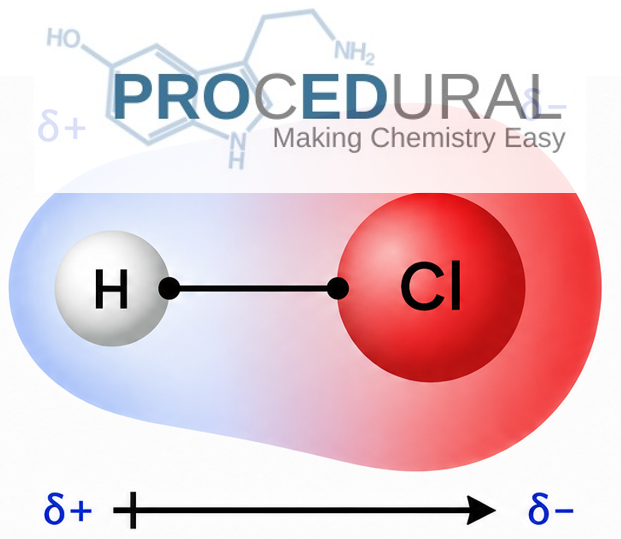
  3. Use intra-molecular bonding and Lewis structures to establish inter-molecular interactions
  4. Use inter-molecular interactions to predict properties of molecules

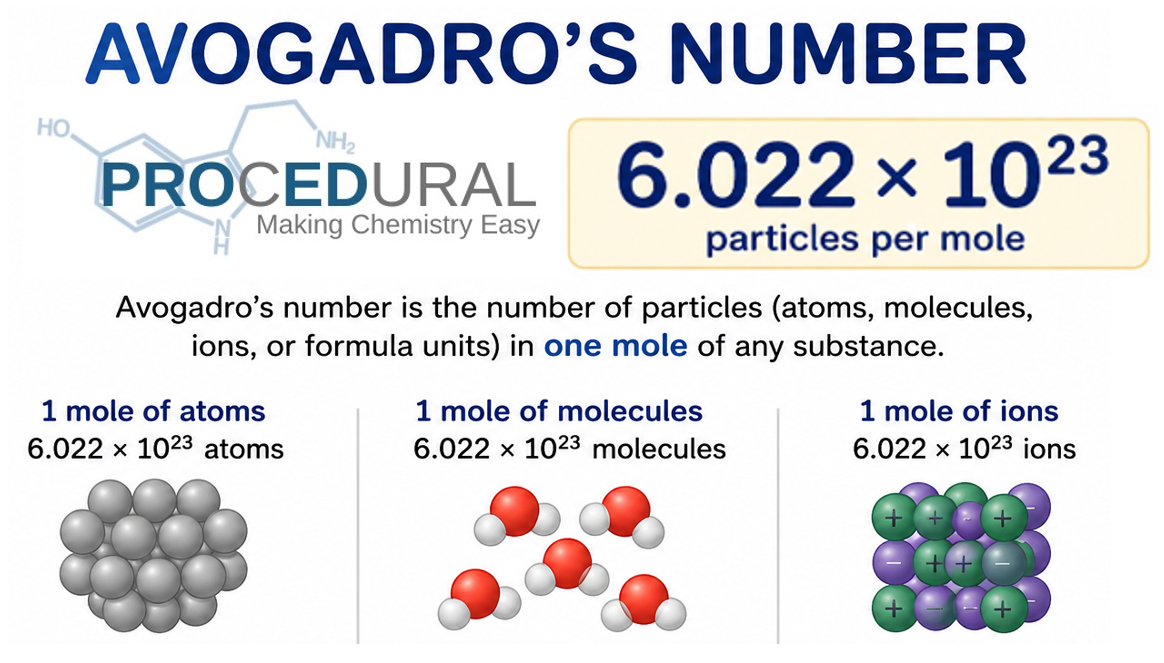
Using the amount to base all chemical calculations on, establish molar mass and the calculation between mass, concentration and volume.
Learning objectives, tick them off as you are able to:

  1. Appreciate that amount in chemistry is measured in mole - n
  2. Use atomic molar masses to calculated molecular molar masses - M
  3. Associate measurable mass - m to the molar mass - M and amount - n  
  4. Associate measurable volume - v to the amount - n and 
    concentration - c
  5. Be able to evaluate amount stoichiometrically in a balanced chemical equation to assess limiting reagents and yields
  6. Be able to evaluate amount stoichiometrically in a balanced chemical equation to assess amounts of each chemical at equilibrium*
    *see 04. Equilibria course for more information later in the course

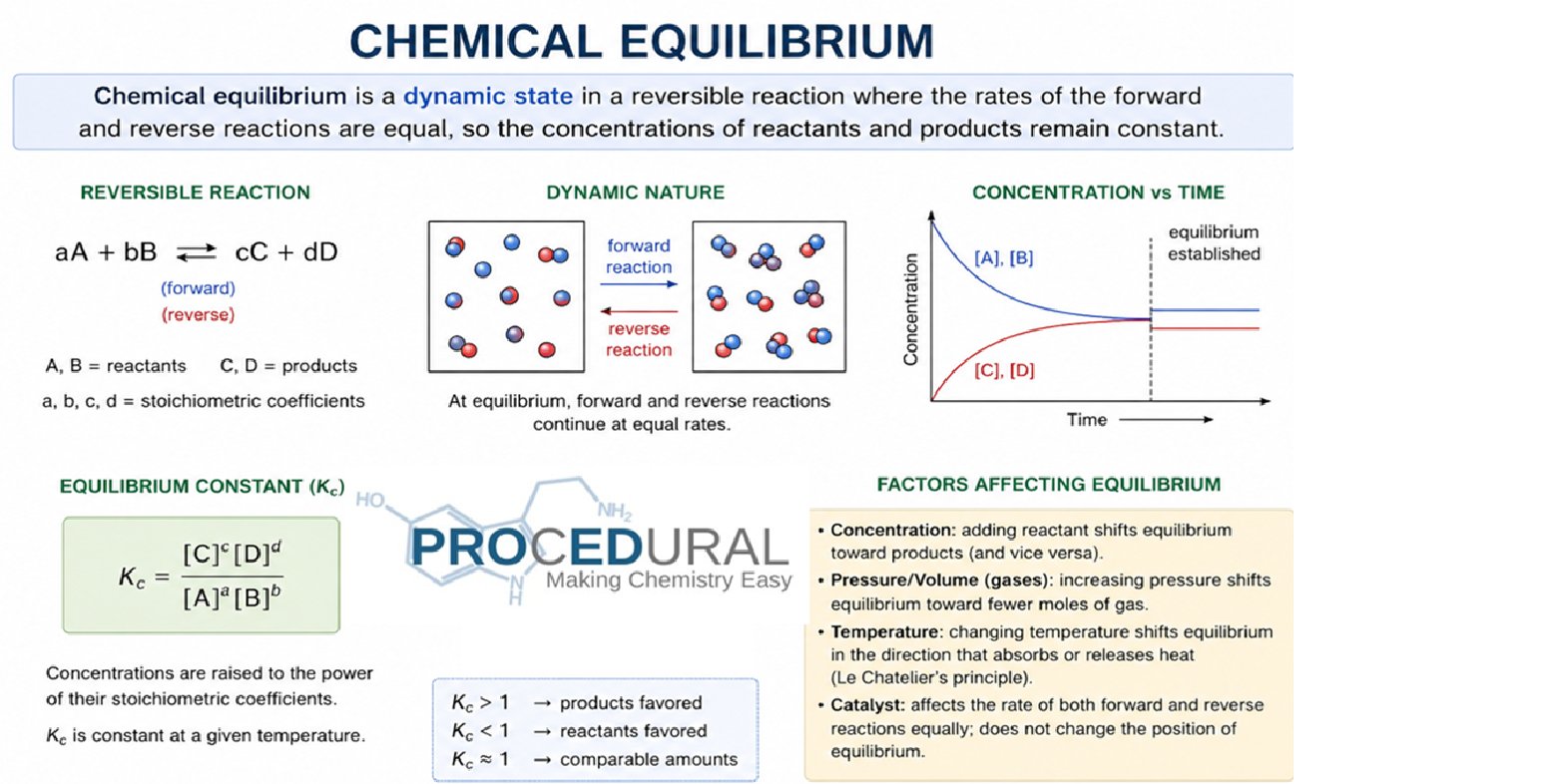
Understanding the tendency of reactions to energetically move towards their stable equilibrium position.  
Learning objectives, tick them off as you are able to:

  1. Appreciate the term equilibrium in relation to chemical reactions
  2. Be able to establish the affect on a equilibrium by changes to the system
  3. Be able to write and calculate information from equilibrium (K) expressions
  4. Be able to write and interpret information from reaction quotients (Q)
  5. Understand that acid/base chemistry is an equilibrium system
    1. Be able to write balance acid/base equilibria, identifying conjugate pairs
    2. Establish and used Ka and Kb expressions
    3. Use -log (p) mathematical conversions to pKa and pH etc
    4. Understand how buffer systems function
    5. Be able to mathematically derive pH changes in a buffer system
    6. Be able to describe, calculate and justify changes to pH during an acid-base titration
  6. Understand that solubility is an equilibrium system 
    1. Be able to identify the type of salt (1:1, 1:2)
    2. Be able to write balance acid/base equilibria, for sparingly soluble salts
    3. Be able to establish and calculate solubility and Ksp 
    4. Identify whether a precipitate will form by calculating and interpreting Qsp values

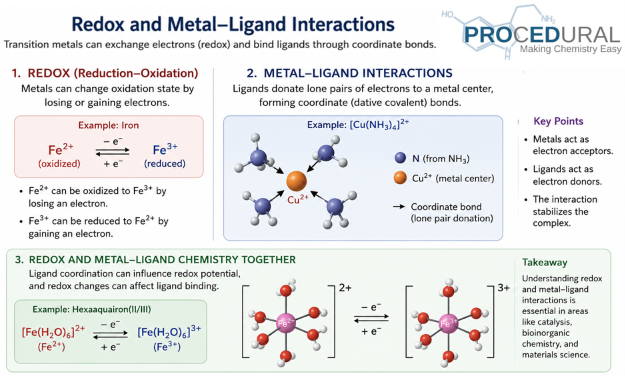
Using the concept of electron transfer in chemistry to have reactions described at reduction and oxidation, then using other bonding and stability concepts to predict or explain the changes in metals and ligands.
Learning objectives, tick them off as you are able to:

  1. Identify a reaction as oxidation or reduction
  2. Be able to balance a redox half equation and whole equation
  3. Be able to identify the species acting at the oxidant (oxidising agent) and reductant (reducing agent)
  4. Be able to predict what will be reduced/oxidised from reduction potentials (E)
  5. Know about metal complex formation
  6. Appreciate the affect a metal had on a ligand's propertied (electrophilicity, pKa)
  7. Appreciate the affect a ligand has on a metal's properties (E values)

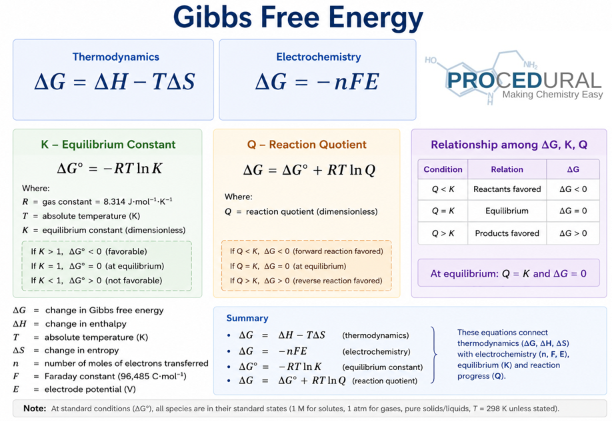
By a fundamental understanding of systems wanting to move to equilibrium using different forms of energy: entropy, enthalpy, chemical and electrical energies, that the overall Gibb's Free energy (ΔG) released/required can be calculated and spontaneity predicted:
Learning objectives, tick them off as you are able to:

  1. Use bond energy to establish change in enthalpy (ΔH)
  2. Use disorder to establish change in entropy (ΔS)
  3. Use Hess's law for entropy (ΔS), enthalpy (ΔH) and Gibb's Free Energy (ΔG)
  4. Use ΔS and ΔH to calculate ΔG
  5. Appreciate the relationship between K and Gibb's Free Energy (ΔG)
  6. Calculate Gibb's Free Energy (ΔG) from K
  7. Gibb's Free Energy (ΔG) to reach equilibrium from Q
  8. Use reduction potentials (E) to calculate Gibb's Free Energy (ΔG)
  9. Use reduction potentials (E) to calculate Gibb's Free Energy (ΔG) to reach equilibrium from Q

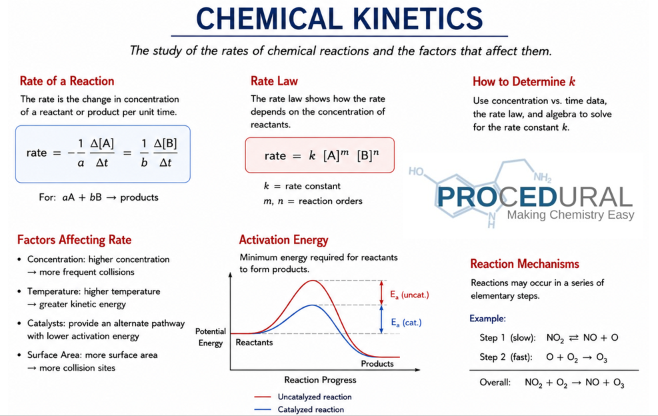
Being able to establish that rate is an important measurable factor in chemical reactions to not only establish how fast a reaction is likely to occur, but also what is happening in the mechanism of a reaction.
Learning objectives, tick them off as you are able to:

  1. Be able to calculate the rate of reaction by change in concentration over time
  2. Be able to appreciate the ratio of rates in a reaction relative to the stoichiometry of the balanced equation
  3. Use changes in concentration of reactants to establish the rate order of reach reactants, the reaction law and overall rate order
  4. Be able to evaluate the rate constant (k) for a reaction, including units
  5. Be able to associate experimental rate law with predicted reaction mechanism
  6. Using 1st order kinetics, understand how concentration change can be predicted over time and half-life can be calculated from k
  7. Be able to calculate Ea from the relationship of lnk and 1/T for a reaction

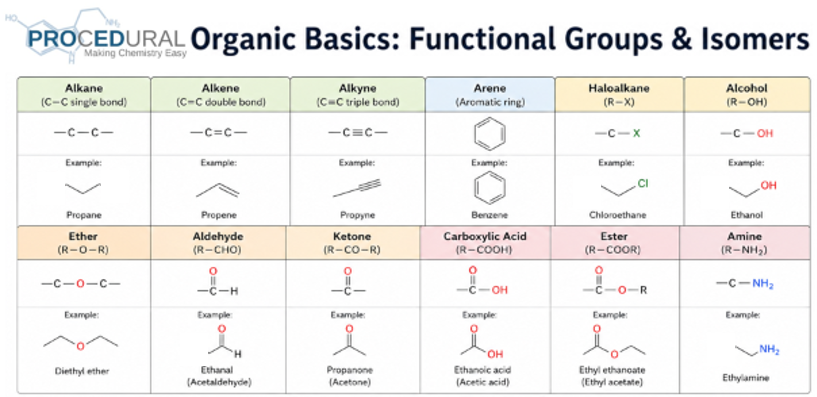
Factors that affect and result from organic chemistry reactions help to understand the larger picture.  This section is to master the terminology, identification and some importance of different parts of organic molecules.
Learning objectives, tick them off as you are able to:

  1. Identify primary (1o), secondary (1o), tertiary (3o) centers and appreciate how this affects their reactivity
  2. Identify C, O, N and S functional groups
  3. Know the products/reactants of organic redox processes 
  4. Understand the differing reactivity of C (especially for carbonyls)
  5. Be able to identify site of isomerism and identify which type is present:
     -structural
     -positional
     -cis (E)/trans (Z)
     -R/S and L/D
     -α/β

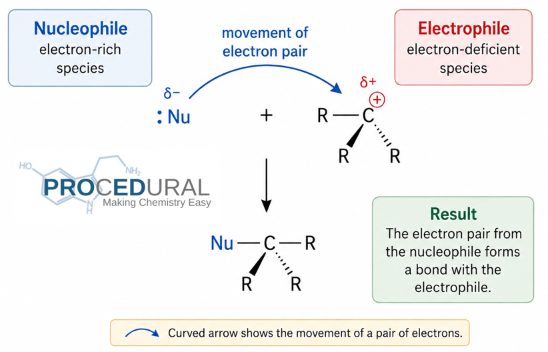
Using reactivity, functional groups and kinetics to describe the mechanism of organic reactions using mechanistic arrows.
In each of the reactions, identify the nucleophile and electrophile, the rate determining step and therefore use of catalysts and ideal reaction conditions and possible alternate products.
Learning objectives, tick them off as you are able to:

  1. Sn1 and Sn2
  2. E1 and E2
  3. Addition  
  4. Carbonyl substitution
  5. Carbonyl addition

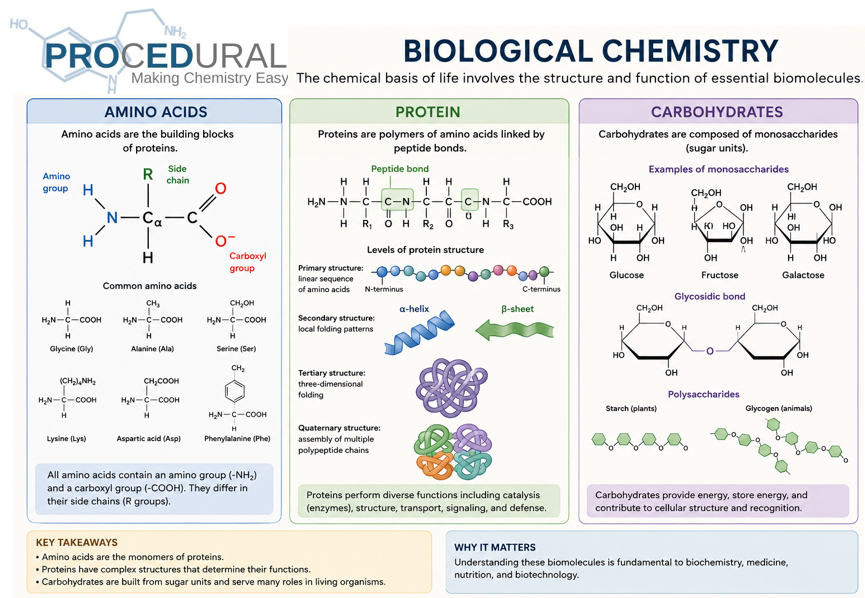
Using all of the chemistry from the previous sections, apply the logic to chemistry in a biological setting.
Learning objectives, tick them off as you are able to:

  1. Amino Acids -
    a)  Know the structure of amino acids, including α- NH2 and -COOH groups and differences in sidechains
    b)  Know the reactivity of the α- NH2 and -COOH groups to make amides (peptide bonds)
    c) Know the acid base properties of α- NH2 and -COOH groups and sidechain groups
    d)  Appreciate how these structures lead to primary (1o), secondary (2o), tertiary (3o) and quaternary (4o) structure of protein
  2. Carbohydrates -
    a)  Be able to differentiate between furanose/pyranose, pentose/hexose,
         L/D and α/β in a sugar molecule
    b)  Be able to identify the anomeric carbon of a sugar molecule, name any
         glycosidic linkage and established whether it is reducing/non-reducing
         (acetal/hemi-acetal) and tests for these.
  3. Appreciate the functionality of lipids in biological chemistry

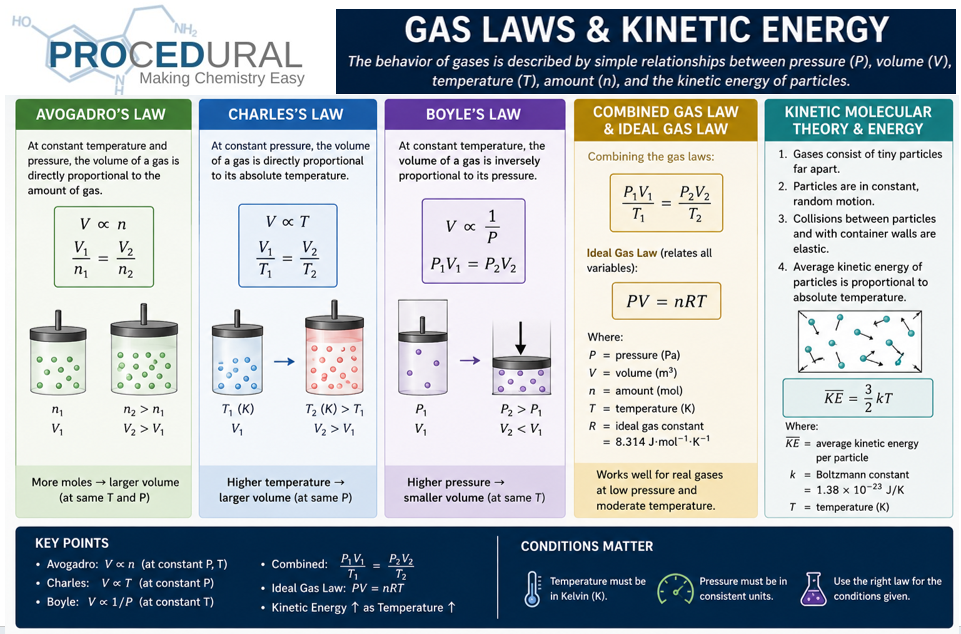
Using ideal gas situations, be able to describe and mathematically manipulate the gas laws, including converting between units to SI units
Learning objectives, tick them off as you are able to:

  1. Master Avogadro's Law
  2. Master Boyle's Law
  3. Master Charles's Law
  4. Master Dalton's Law
  5. Solve using the Ideal Gas equation
  6. Calculate the kinetic energy of gas molecules
  7. Master Graham's Law of diffusion